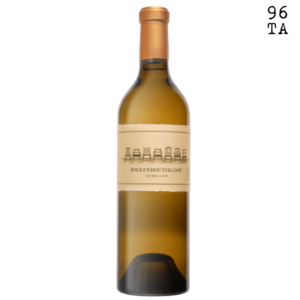
Our Semillon is made from Certified Heritage Vineyards, which count amongst the oldest in South Africa. These three Franschhoek Semillon vineyards have acclimated to their terroirs, producing unique wines with intense depth and complexity. These old vineyards’ deep root systems and high skin-to-pulp ratio produce intensely complex, well-structured wines with unbelievable ageing potential.
Two of the vineyards used for our Semillon, planted in 1902 and 1942, are unirrigated bush vines, growing on little to no slope in the ancient Franschhoek Riverbed. These vineyards are well established on alluvial soils with a high loam content. The third vineyard planted in 1936, is located further up the valley on a 45-degree south-facing slope, on decomposed granite and quartz soils. Some of the vines within these vineyards have naturally mutated from Semillon to Semillon Gris, which has a slight red hue and higher skin-to-pulp ratio. The Semillon Gris vines naturally require more ripening time and are only harvested during a second picking. We opted to use a small portion of historic Muscat d’Alexandrie, planted in 1902, to enhance the wine’s aromatic character.
The months leading into the 2023 harvest were ideal, with warm but moderate conditions, good soil moisture, and healthy vines, indicating a long and even ripening season. An unseasonal rain event in mid-March posed challenges for the later-ripening parcels (1902 Semillon & 1902 Muscat d’Alexandrie), but favourable conditions earlier in the season ensured successful ripening. These conditions resulted in a high-quality vintage, characterised by balance, purity, and structure in the Franschhoek Semillon.